
How AI Is Transforming Digital Marketing in the Future
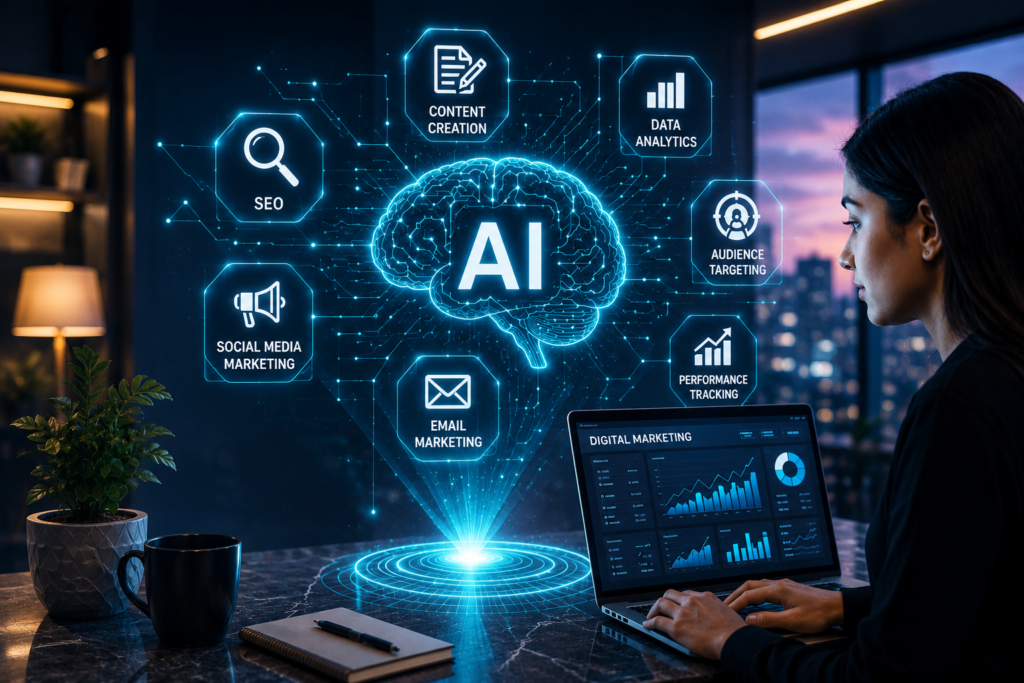
Artificial intelligence is no longer a “future trend” in digital marketing — it’s already reshaping how brands connect with customers, create content, and make decisions. As a Digital Marketing Expert in Palakkad, Kerala, I see this shift happening in real time across businesses of every size. But this is only the beginning. As AI in digital marketing becomes smarter and more deeply integrated into everyday marketing workflows, the way businesses plan, execute, and measure campaigns is set to change dramatically. Here’s a closer look at how AI in digital marketing is transforming the field, and what the future holds.
SEPTEMBER, 9, 2026.
1. Hyper-Personalization Will Become the Standard
Today, AI already analyzes browsing behavior, purchase history, and engagement patterns to personalize content. In the future, this will go much deeper — brands will be able to deliver real-time, individualized experiences across every channel, not just occasionally, but as the default way of marketing.
- Product recommendations tailored to each visitor, updated instantly
- Personalized email and ad content generated automatically for different audience segments
- Dynamic website experiences that change based on who’s viewing them
- Predictive suggestions based on what a customer is likely to want next
2. AI Agents Will Run More of the Campaign Work
Marketing platforms are moving from single AI tools to multiple specialized AI agents working together — one handling content, another handling targeting, another handling reporting, all communicating with each other automatically.
- Agents will manage tasks like media buying, audience segmentation, and performance tracking with minimal manual input
- Marketers will shift from “doing the work” to supervising and strategizing
- Campaign adjustments will happen in real time, without waiting for manual reports
- Full campaign orchestration — from planning to execution — will increasingly run through connected AI systems
3. Search Itself Is Being Redefined
Traditional search engines are no longer the only place people look for answers. Platforms like ChatGPT, Claude, and Google’s AI Overviews are changing how people discover brands and information.
- SEO will expand into “AI visibility” — being cited and recommended inside AI-generated answers, not just ranking on a results page
- Brands that aren’t mentioned in trusted, authoritative sources may get overlooked by AI search entirely
- Structured, well-organized, and genuinely useful content will matter more than keyword-stuffed pages
- Traditional rankings and AI citations will need separate strategies, since they no longer overlap as much as before
4. Predictive Analytics Will Guide Decisions Before Problems Happen
AI’s ability to process massive amounts of data means marketing will shift from reactive to predictive. Instead of reacting to what already happened, businesses will plan around what’s likely to happen next.
- Smarter budget allocation based on anticipated demand, not past performance alone
- Early identification of which leads are most likely to convert
- Content calendars planned around predicted trends and customer behavior
- Reduced guesswork in campaign strategy, leading to more confident decision-making
5. Content Creation Will Be Faster, But Authenticity Will Matter More
AI can already generate blog posts, ad copy, video scripts, and captions in seconds. In the future, this speed will be even greater — but so will the demand for content that feels genuinely human.
- Expect AI to handle first drafts, variations, and repetitive content at scale
- Brands that rely too heavily on generic AI content risk being seen as less trustworthy
- The winning strategy will combine AI speed with human insight, storytelling, and originality
- Platforms are already pushing back against low-effort AI content, rewarding authentic engagement instead
6. Customer Support and Engagement Will Be AI-First
AI-powered chatbots and business agents are becoming far more capable — handling customer questions, product suggestions, appointment booking, and even qualifying leads directly inside messaging apps.
- Instant, 24/7 customer interaction without long wait times
- AI agents that can guide a customer from question to purchase without human handoff
- More businesses, including small and local ones, adopting AI-driven engagement tools
- A shift in customer expectations — instant, helpful responses will become the norm, not a bonus
7. Trust, Transparency, and Ethics Will Shape AI Adoption
As AI becomes more powerful, customers are also becoming more cautious. Many people still hesitate to let AI make decisions for them, especially around purchases.
- Businesses will need to be transparent about where and how AI is used in their marketing
- Data privacy and ethical AI use will become a bigger part of brand trust
- AI will support research and discovery more than it replaces final human decisions, at least in the near term
- Brands that balance automation with a human touch will build stronger, longer-lasting customer relationships
The Bottom Line
AI isn’t replacing marketers — it’s changing what marketing work looks like. In the future, the businesses that thrive won’t simply be the ones using the most AI tools, but the ones that use AI strategically: automating the repetitive, predicting smarter, personalizing deeper, while still keeping genuine human connection at the center of their brand. As a Digital Marketing Expert in Palakkad, Kerala, my goal is to help local businesses adopt these AI-driven strategies the right way. The future of digital marketing belongs to those who can blend AI’s speed and intelligence with authentic, human-first strategy.