
The Ultimate Digital Marketing Guide for Beginners
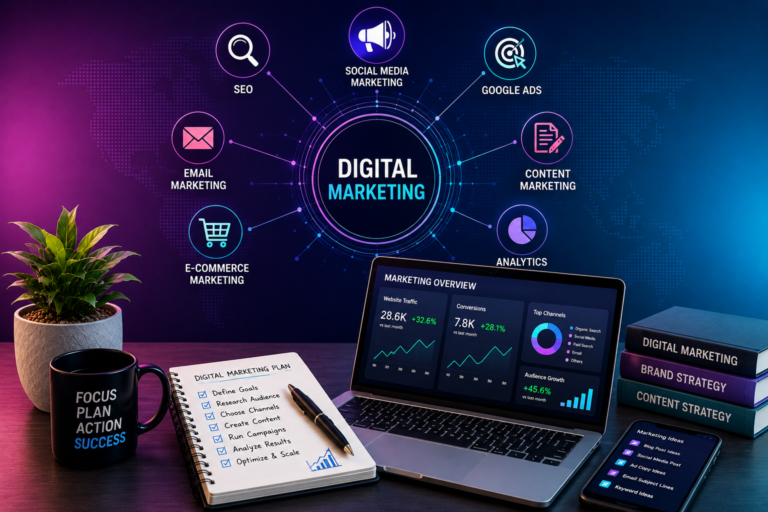
Digital marketing can feel overwhelming when you’re just starting out — so many terms, tools, and platforms, all changing constantly. As a Digital Marketing Expert in Palakkad, Kerala, I get asked almost every week where a true beginner should start. This guide to digital marketing for beginners breaks it down into simple, practical steps that reflect where digital marketing actually stands today — so you can start learning with confidence, without the confusion.
What Digital Marketing for Beginners Really Means
Digital marketing is simply the process of promoting a product, service, or brand using online channels — search engines, social media, email, and mobile apps — instead of traditional methods like print, TV, or billboards.
It helps businesses reach a wider audience without huge budgets
It allows direct communication with customers through websites, email, and social platforms
It’s measurable — you can track exactly what’s working and what isn’t
It works for individuals, freelancers, small businesses, and large companies alike
Core Channels Every Beginner Should Know in Digital Marketing
Before picking a “niche,” it helps to understand the main pillars of digital marketing. Each one plays a different role in helping a business grow.
SEO (Search Engine Optimization) – Improving a website so it ranks higher in search results and gets found organically
Social Media Marketing – Using platforms like Instagram, LinkedIn, YouTube, and TikTok to build brand presence and engage audiences
Content Marketing – Creating valuable blog posts, videos, and resources that attract and educate potential customers
Email Marketing – Building direct relationships with leads and customers through targeted email campaigns
Paid Advertising (PPC) – Running ads on Google, Meta, and other platforms to drive immediate traffic and leads
How Search Has Changed — A Must-Know for Digital Marketing Beginners
This is one of the biggest shifts beginners need to know right now. A few years ago, Google was the default starting point for almost every search. Today, people are just as likely to ask AI tools like ChatGPT, Gemini, or Google’s AI Mode for recommendations, and search behavior has moved toward longer, more conversational questions instead of short keyword phrases.
SEO now includes optimizing for AI-generated answers and summaries, not just traditional search rankings — this is often called Generative Engine Optimization (GEO) or Answer Engine Optimization (AEO)
Being mentioned in trustworthy, authoritative sources matters more than ever, since AI tools tend to cite sources they consider credible
Beginners should learn both classic SEO fundamentals (keywords, technical SEO, backlinks) and how AI search tools pull and structure information
Learn About Privacy-First Marketing
Another major shift beginners should know about: third-party cookie tracking has largely faded, replaced by privacy-first approaches. For beginners, this is actually good news — it means less “creepy” tracking and more focus on genuine trust-building.
First-party data – Information collected directly through your own website, purchases, or email engagement
Zero-party data – Information customers willingly and proactively share with a brand
Building trust with an audience now matters as much as building traffic
AI Tools Every Digital Marketing Beginner Should Use
AI is no longer optional knowledge for beginners — it’s part of the everyday toolkit for marketers at every level.
Use AI tools like ChatGPT or Claude to help draft content, brainstorm ideas, and speed up research
Learn beginner-friendly design tools like Canva AI for creating graphics without needing design skills
Explore free SEO tools first (like Google Search Console) before investing in paid platforms like Semrush or Ahrefs
Remember: AI handles the heavy lifting, but understanding your audience’s real needs is still a human skill
Build Real Skills, Not Just Theory
Reading about digital marketing only gets you so far — beginners grow fastest by practicing on real (even small) projects.
Start a blog, social page, or small project to apply what you’re learning
Choose one or two platforms to focus on consistently, rather than spreading yourself across everything
Track your results using free analytics tools to understand what’s actually working
Basics can realistically be learned in 3 to 6 months with consistent practice — mastery comes with ongoing learning
Career Paths in Digital Marketing for Beginners
Digital marketing remains one of the fastest-growing career fields, with strong opportunities whether you want a job, freelance work, or to grow your own business.
No advanced technical background is required to begin — basic computer literacy is enough to start
Roles range from SEO specialist and social media manager to performance marketer and content strategist
Freelancing and consulting are realistic paths once you’ve built a portfolio of real results
Businesses across almost every industry now need people who can help them grow online
The Bottom Line
Digital marketing today isn’t about random posting or guesswork — it’s a skill built on strategy, data, privacy-conscious trust-building, and smart use of AI tools. As a Digital Marketing Expert in Palakkad, Kerala, my advice to every beginner is the same: start with the fundamentals, get hands-on with real projects, and let AI support your work rather than replace your thinking. Master the basics well, and the tools will always be easier to pick up along the way.
Written by Shahana — Digital Marketing Expert, Palakkad, Kerala